California Workers’ Comp Changes September 1, 2026: What’s Changing for Employers?
August 2026


August 2026
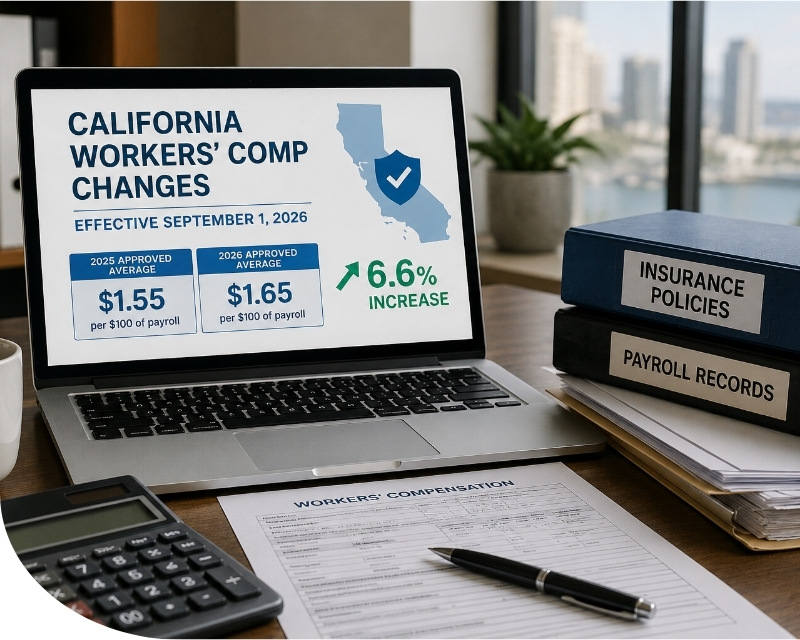
California employers have another workers’ compensation date to watch: September 1, 2026.
The California Insurance Commissioner has approved a new average advisory pure premium rate of $1.65 per $100 of payroll for workers’ compensation policies incepting on or after September 1, 2026. That represents a 6.6% increase from the average advisory rate approved for September 1, 2025.
But that does not mean every California employer’s workers’ compensation premium will increase by 6.6%.
The advisory rate is a benchmark used within California’s workers’ compensation system. Individual insurers establish their own rates, and what a business actually pays can depend on multiple factors specific to that employer.
Alongside the advisory rate change, California is implementing updates to experience rating and classification rules that may also be relevant to employers.
Here’s what is changing September 1 and what California business owners should review as they approach their next workers’ compensation renewal.
The California Department of Insurance approved an average advisory pure premium rate of $1.65 per $100 of payroll, effective for policies incepting on or after September 1, 2026.
The approved figure is 6.6% higher than the September 1, 2025 approved average of $1.55.
The Workers’ Compensation Insurance Rating Bureau of California (WCIRB) had initially recommended an average advisory pure premium rate of $1.71, which would have represented a larger increase. The Insurance Commissioner ultimately approved $1.65.
The September changes also include updates to California’s Experience Rating Plan and classification rules.
For employers, there are therefore several separate issues to understand:
That last point is particularly important.
No. A 6.6% increase in California’s average advisory pure premium rate does not mean every employer’s workers’ compensation bill will increase by 6.6%.
California’s advisory pure premium rates are benchmarks intended to reflect the cost of workers’ compensation losses and loss-adjustment expenses. They are not the final rates every insurer must charge businesses.
Insurance companies establish their own rates, and an employer’s premium can be affected by factors such as:
Two businesses in the same city can therefore have very different workers’ compensation premiums.
For a business owner, the more useful question isn’t simply, “How much did the statewide benchmark change?”
It is: “How could the September changes interact with my business, classifications, loss experience, and upcoming renewal?”
The September adjustment comes amid increasing cost pressures in California’s workers’ compensation system.
In its 2026 decision, the California Department of Insurance noted rising medical costs and other system pressures when establishing the new benchmark.
This is also why the distinction between an advisory rate and an employer’s actual insurance premium matters.
Statewide workers’ compensation data can indicate the direction of underlying system costs, but it cannot predict what one particular San Diego restaurant, contractor, retailer, office, or other small business will pay.
Business owners should therefore be cautious about applying statewide percentage changes directly to their own policies.
The advisory pure premium rate isn’t the only September 1 change.
California is also implementing updates to the Experience Rating Plan.
Experience rating is designed to compare an employer’s actual loss experience with the expected loss experience for similar businesses. Qualifying employers may receive an experience modification, commonly referred to as an X-Mod or experience modification factor.
Beginning September 1, 2026, California’s experience rating eligibility threshold increases from $10,800 to $11,700.
Other experience-rating components are also being updated, including expected loss rates, D-ratios, and primary thresholds.
For many small business owners, there is no reason to become an expert in the underlying formulas. What matters is understanding that experience rating can play an important role in workers’ compensation costs for qualifying employers.
A business approaching renewal should know whether it is experience-rated and whether its loss history, payroll, or business operations have changed.
California’s September 1 regulatory updates also include changes involving workers’ compensation classifications and payroll rules.
Classifications matter because workers’ compensation risk varies significantly depending on the work employees perform.
An office employee, for example, generally presents a different workplace injury exposure than an employee performing roofing, electrical, plumbing, or other construction work.
The September 2026 updates include revisions affecting certain classifications, as well as changes involving minimum and maximum payroll limitations and construction dual-wage thresholds.
This makes accurate classification especially important for businesses whose workforce, job duties, or operations have changed.
Contractors are a good example of why workers’ compensation shouldn’t be treated as a policy that is simply renewed and forgotten.
A contractor may have:
Any of these changes can make a policy review worthwhile, independent of the statewide September 1 changes.
There is no single answer that applies to every California employer.
The approved advisory pure premium rates apply to policies incepting on or after September 1, 2026, but the actual premium for an individual business depends on its circumstances and the insurer providing coverage.
That means business owners shouldn’t assume either that their premium will increase by the statewide percentage or that the September changes will have no effect on them.
Instead, employers approaching a renewal should look at the factors that actually influence their policy.
Workers’ compensation premiums are closely connected to payroll. Significant increases or decreases in payroll can affect the eventual premium.
Employees should be classified according to the work they actually perform. Changes in job duties or operations can create classification issues that deserve attention before renewal.
Past workplace injuries and claims can affect an employer’s workers’ compensation profile, particularly for experience-rated businesses.
H&M Insurance has also covered how claims vary across San Diego industries and what employers can do to reduce common workplace risks.
For businesses subject to experience rating, the X-Mod can be an important component of workers’ compensation pricing.
Understanding the factors behind an unfavorable modification can be more useful than focusing only on the statewide advisory rate.
A policy originally written for one version of a company may not accurately reflect that company several years later.
New locations, services, equipment, employees, or operational changes should be discussed with an insurance professional.

Before renewal, consider reviewing:
A renewal review isn’t necessarily about finding the cheapest policy. The objective should be making sure the information used to insure the company is accurate and that the coverage remains appropriate for its current operations.
Workers’ compensation and general liability are sometimes confused, but they address different types of risk.
Workers’ compensation generally addresses work-related employee injuries and illnesses, while general liability insurance addresses certain third-party bodily injury, property damage, and related liability exposures.
A change to California workers’ compensation rules doesn’t replace or eliminate a company’s need to evaluate its other commercial insurance coverage.
Business owners who are unsure where one policy ends and another begins can review the differences before making coverage decisions.
The approved September 2026 advisory pure premium rates apply to workers’ compensation policies incepting on or after September 1, 2026.
That does not mean every existing policy automatically changes on September 1.
How the regulatory changes relate to a particular employer will depend on factors including the policy’s effective dates, insurer, rating information, and individual business circumstances.
Employers with renewals approaching September 1 or later may want to review their policy information ahead of time rather than waiting until the renewal is due.
California approved an average advisory pure premium rate of $1.65 per $100 of payroll, effective September 1, 2026. This is 6.6% above the average advisory rate approved for September 1, 2025. However, advisory pure premium rates are not the final rates insurers must charge, so an individual employer’s premium will not necessarily increase by 6.6%.
An advisory pure premium rate is a benchmark associated with the expected cost of workers’ compensation losses and loss-adjustment expenses. It is not a quote or mandatory retail price for an employer’s workers’ compensation policy.
The new advisory pure premium rates and several related regulatory changes take effect September 1, 2026. The approved advisory rates apply to policies incepting on or after that date.
Yes. Among the changes effective September 1, 2026, the experience-rating eligibility threshold increases from $10,800 to $11,700. Other experience-rating values are also being updated.
Not necessarily. Reviewing payroll, employee classifications, claims information, business changes, and other policy details before renewal can give an employer time to address questions or inaccurate information.
The September 2026 workers’ compensation changes don’t produce the same result for every California employer.
The statewide advisory benchmark is increasing, experience-rating rules are being updated, and certain classification-related rules are changing. But an individual company’s workers’ compensation premium still depends on its own risk characteristics, payroll, classifications, loss experience, insurer, and other rating factors.
For San Diego County business owners, the practical next step is to understand how the company has changed since its last policy was written and whether the current workers’ compensation program still reflects those operations.
If your workers’ compensation renewal is approaching, H&M Insurance can review your current business information and help you evaluate your workers’ compensation insurance options.
Sources
Insurance requirements, rates, eligibility, and coverage vary by business, insurer, policy, and individual circumstances. This article provides general information and should not be treated as a quote or guarantee of premium.