Certificates of Insurance (COI): What San Diego Businesses Need to Know
July 2026



July 2026
If you’ve been asked to provide a Certificate of Insurance (COI), you’re probably close to signing a contract, leasing commercial space, hiring a subcontractor or starting work for a new client. Many businesses encounter this requirement long before they ever file an insurance claim.
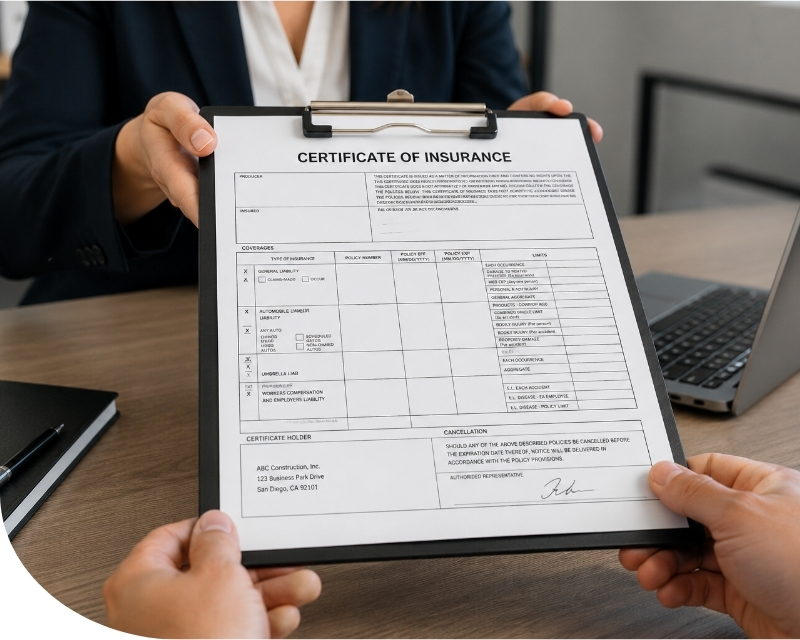
A Certificate of Insurance is a simple document, but it plays an important role in business. It gives clients, landlords, property managers and other third parties confirmation that your insurance policies are active and that your business carries the requested coverage.
In this article, you’ll learn what a Certificate of Insurance is, what information it includes, when you may need one, and how to request it. We’ll also explain the difference between a certificate holder and an additional insured, since these terms are often confused.
If you’re looking for business insurance in San Diego, understanding how Certificates of Insurance work can help you avoid delays, meet contract requirements, and keep projects moving forward.
A Certificate of Insurance (COI) is a document that summarizes your business insurance coverage. It provides proof that your insurance policies are active on the date the certificate is issued and outlines key policy information.
A COI is not the insurance policy itself. Instead, it serves as a snapshot of your coverage, making it easy for clients, landlords, property managers, vendors and other businesses to verify that your company carries the required insurance.
In most cases, a Certificate of Insurance includes:
Many contracts require a COI before work begins. Providing one promptly demonstrates that your business has the requested insurance coverage and is ready to meet contractual obligations.
It’s also important to understand what a COI does not do. A Certificate of Insurance does not change your policy, add new coverage or modify policy limits. It simply summarizes the insurance that is already in place.
Many business owners don’t think about Certificates of Insurance until someone requests one. In reality, COIs are part of everyday business operations across many industries.
You may be asked to provide a Certificate of Insurance when you:
For example, a property manager may require proof of general liability insurance before allowing a contractor to begin renovations. A retailer participating in a weekend festival may need to provide a COI before setting up a booth. A cleaning company servicing office buildings may be required to submit updated certificates each year as part of its service agreement.
In many situations, providing a COI is simply part of doing business. Having an established relationship with your insurance agency can make the process much faster when a client requests proof of coverage on short notice.
Although Certificates of Insurance can vary slightly depending on the insurance carrier, most contain the same core information. Understanding each section helps you confirm that the certificate meets the requirements of your client, landlord or contract.
Before sending a COI to a client, review it carefully to make sure all information is accurate. Even a small error, such as an incorrect business name or certificate holder, can delay a project or contract approval.
Some contracts also require specific coverage limits or endorsements. If your certificate doesn’t reflect those requirements, your insurance agent may need to update your policy or issue additional documentation.
One of the most common misconceptions is that a certificate holder and an additional insured are the same thing. They are not.
A certificate holder is simply the person or organization that receives the Certificate of Insurance as proof your policy exists.
Being listed as a certificate holder does not provide insurance coverage or legal protection under your policy. It only confirms that the requested insurance was in effect when the certificate was issued.
Examples of certificate holders include:
An additional insured is a person or organization that has been added to certain parts of your insurance policy through an endorsement. Depending on the policy language and circumstances of the claim, they may receive coverage for covered claims arising out of your work or operations.
Many construction contracts, commercial leases and vendor agreements require businesses to add another party as an additional insured, not simply provide a Certificate of Insurance.
For example, a general contractor may require a subcontractor to name the general contractor as an additional insured before work begins. Likewise, a commercial landlord may request additional insured status as part of a lease agreement.
It’s important to understand that a Certificate of Insurance alone does not make someone an additional insured. If a contract requires additional insured status, your insurance policy must include the appropriate endorsement.
This is one reason businesses should review insurance requirements before signing contracts. Addressing these requests early can prevent delays once work is scheduled to begin.
Requesting a Certificate of Insurance is usually a quick process, especially if your policy is already active. Most insurance agencies can issue a standard COI within the same business day, provided no policy changes are required.
To request a certificate, you’ll typically need to provide:
Once your request is received, your insurance agency will review your policy to confirm it meets the requested requirements. If everything is in place, they’ll prepare the Certificate of Insurance and send it directly to you, the certificate holder, or both.
If the requested coverage or policy limits differ from your current policy, your agent will discuss available options before issuing the certificate.
For most businesses, a standard Certificate of Insurance can be issued the same day. More complex requests may take longer if they involve:
Submitting your request as early as possible helps avoid delays, particularly if you’re preparing for a project with a fixed start date or closing on a commercial lease.
Certificates of Insurance are used across nearly every industry, but some businesses are asked to provide them on a regular basis as part of contracts, leases or vendor agreements.
General contractors, subcontractors, electricians, plumbers, HVAC companies, landscapers, painters and other trades are routinely asked to provide Certificates of Insurance before starting work. Property owners and general contractors often require proof of insurance to confirm that the contractor carries the necessary liability coverage.
For many contractors, maintaining appropriate general liability insurance is an essential part of meeting contract requirements.
Janitorial companies, window cleaners, pressure washing businesses, and facility maintenance providers frequently work on client premises. Property managers and business owners commonly request a COI before granting access to office buildings, retail centers or industrial facilities.
Restaurants, food trucks, caterers, and event vendors may need Certificates of Insurance when participating in festivals, farmers markets, private events, or operating inside leased commercial spaces. Event organizers often require proof of liability insurance before approving vendors.
Retail stores may be asked to provide Certificates of Insurance by shopping centers, landlords, or vendors. Businesses participating in trade shows or temporary retail events are also commonly required to submit proof of insurance before setup.
Property managers often request Certificates of Insurance from contractors, maintenance companies, landscapers and other service providers before allowing work to begin on the property.
Consultants, marketing agencies, IT companies, engineers, architects, accountants, and other professional firms may need to provide a COI before signing service agreements with corporate clients or government agencies.
Regardless of your industry, being able to provide proof of insurance quickly demonstrates professionalism and helps prevent unnecessary delays when new business opportunities arise.
Most COI issues are easy to prevent. Taking a few minutes to review the certificate before sending it can help avoid delays and unnecessary back-and-forth with clients or property managers.
Many contracts require proof of insurance before work can begin. Waiting until the day a project starts may delay approval if your policy needs to be updated or additional documentation is required.
A misspelled business name or incorrect address may seem minor, but some organizations will reject a Certificate of Insurance until the information matches the contract exactly.
A Certificate of Insurance only summarizes your existing policy. It does not increase policy limits, add endorsements, or modify coverage. If a contract requires additional protection, your policy must first be updated before a revised certificate can be issued.
Many businesses provide a Certificate of Insurance without realizing the contract also requires additional insured status. If this requirement is overlooked, the certificate alone may not satisfy the agreement.
Some contracts specify minimum liability limits before work can begin. Review these requirements carefully to confirm your policy meets them before requesting a certificate.
A quick conversation with your insurance agent can often resolve these issues before they become project delays

A Certificate of Insurance should never become the reason a project is delayed.
If you’re signing a commercial lease, beginning work for a new client, or responding to a contract requirement, having the right insurance and the ability to provide a COI promptly helps keep projects moving and demonstrates that your business is prepared to meet professional expectations.
At H&M Insurance, we help San Diego businesses obtain the coverage they need and issue Certificates of Insurance quickly when they’re requested. If your contract requires specific coverage limits, additional insured status, or other endorsements, we’ll review the requirements with you before the certificate is issued.
If you’re reviewing your current coverage or purchasing a new policy, our team can also help you choose the right insurance solutions for your San Diego business before certificate requests arise.
Call (619) 296-0005 or contact us to speak with a licensed agent.
Disclaimer
This article is for informational purposes only and does not constitute legal, insurance or contractual advice. Certificate of Insurance (COI) requirements, policy terms, endorsements, and contractual obligations vary by insurer, policy and agreement. Consult a licensed insurance agent before relying on a Certificate of Insurance to satisfy contract or coverage requirements.